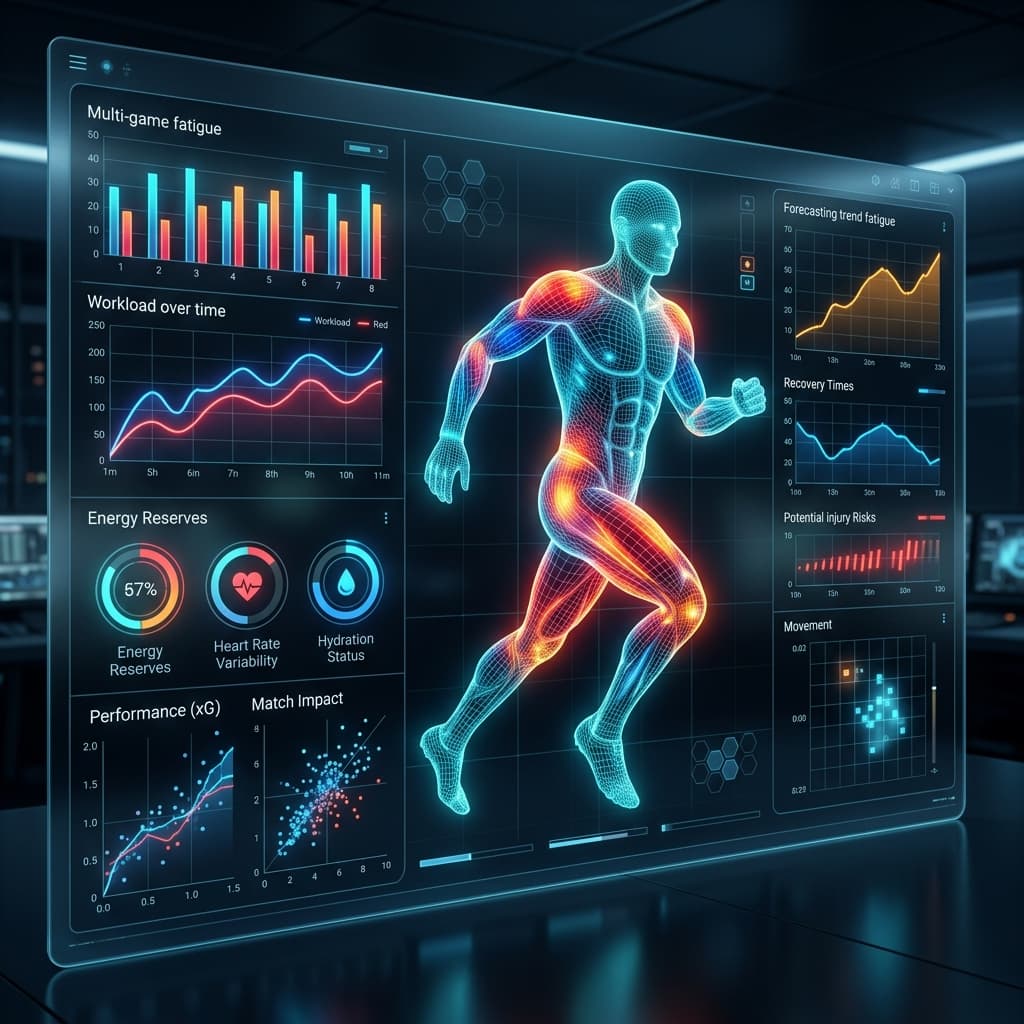
For the last decade, Expected Goals (xG) has been the undisputed gold standard of football analytics. It revolutionized how analysts, bettors, and club directors evaluate team performance, stripping away the noise of lucky bounces and focusing purely on the underlying quality of chances created. However, as the market matures, the alpha generated by simple xG models is rapidly decaying.
The fundamental flaw of xG is that it is purely a descriptive metric—it tells us what happened in the past. To find true value in modern football, analytics must shift from descriptive to predictive. And the most critical variable missing from traditional predictive models is human physiology.
The Limitation of Static Metrics
The problem with traditional spatial metrics is that they assume players operate in a static vacuum. A machine learning algorithm might calculate that an elite striker has a 25% probability of scoring from a specific coordinate inside the penalty area. But what if that striker has played 270 minutes in the last 8 days? What if he just completed a transatlantic flight after an international break? What if the ambient temperature on the pitch is 32°C (90°F) with 80% humidity?
Human physiology heavily impacts split-second decision-making, muscle explosiveness, and reaction times. These are factors that static xG or Expected Assists (xA) models completely ignore. A pass that is easily intercepted by a fresh defender in the 15th minute might seamlessly break the lines against that exact same defender in the 82nd minute if their lactate levels have peaked.
Introducing the Dynamic Fatigue Index
This is where dynamic Fatigue Modeling comes into play, representing the next paradigm shift in football intelligence. By moving beyond simple "minutes played" and integrating highly granular data, we can calculate a real-time, predictive physiological state for every player on the pitch.
Building a robust Fatigue Index requires synthesizing multiple complex datasets:
- Kinematic Workload: Not just distance covered, but the volume of high-intensity sprints, accelerations, and decelerations. Decelerations, in particular, cause the highest degree of micro-muscular damage.
- Travel and Circadian Disruption: Calculating the exact sleep debt and circadian rhythm disruption a player experiences when traveling across multiple time zones for Champions League or International fixtures.
- Historical Recovery Curves: Analyzing a player's individual historical data to understand their unique biological recovery rate. Player A might recover from a 90-minute match in 48 hours, while Player B requires 72 hours to reach the same baseline.
- Environmental Stressors: Real-time adjustments for altitude, temperature, and pitch condition (e.g., heavy rain significantly increases the metabolic cost of running).
By feeding these variables into a neural network, analysts can generate a live "Fatigue Index" (scored from 1 to 100) for every player.

Tactical Exploitation and Market Arbitrage
For quantitative analysts and algorithmic traders, the Fatigue Index is an incredibly potent weapon. It allows for the identification of structural weaknesses before they manifest visually on the pitch.
Scenario: The Second-Half Collapse
Imagine a scenario where a mid-table team is holding a 0-0 draw against a title contender at half-time. Traditional live betting odds might heavily favor the draw, assuming the underdog's defensive block is holding firm.
However, a predictive Fatigue Model might reveal that the underdog's double-pivot in midfield has operated at a 90% fatigue threshold since the 35th minute, having chased the ball relentlessly. The model predicts a catastrophic drop in their spatial awareness and closing-down speed between the 60th and 75th minute.
Armed with this data, a sports trader can take a highly leveraged position on the favorite scoring in the second half, securing massive odds before the bookmakers realize the physical collapse is imminent.
Scenario: Tactical Recommendations
From a coaching perspective, the applications are equally profound. If a live model indicates that the opponent's right-back is suffering from acute localized fatigue (due to a high volume of overlapping sprints), the manager receives a direct, data-driven recommendation: substitute on a fresh, highly explosive winger on the left flank and force the fatigued defender into one-on-one isolation.
The Future of Football Analytics
As the football calendar becomes increasingly congested with expanded tournaments and international duties, the physical toll on players is reaching breaking point. The clubs, syndicates, and analysts who can accurately model, predict, and exploit physical exhaustion will dominate the sport over the next decade.
At FootINet, our proprietary AI models are constantly calculating these physiological variables in the background. We don't just tell you the xG of a shot; we tell you the exact probability of a defender having the physical capacity to block it in the 89th minute. xG was just the beginning; the future belongs to dynamic physiological modeling.