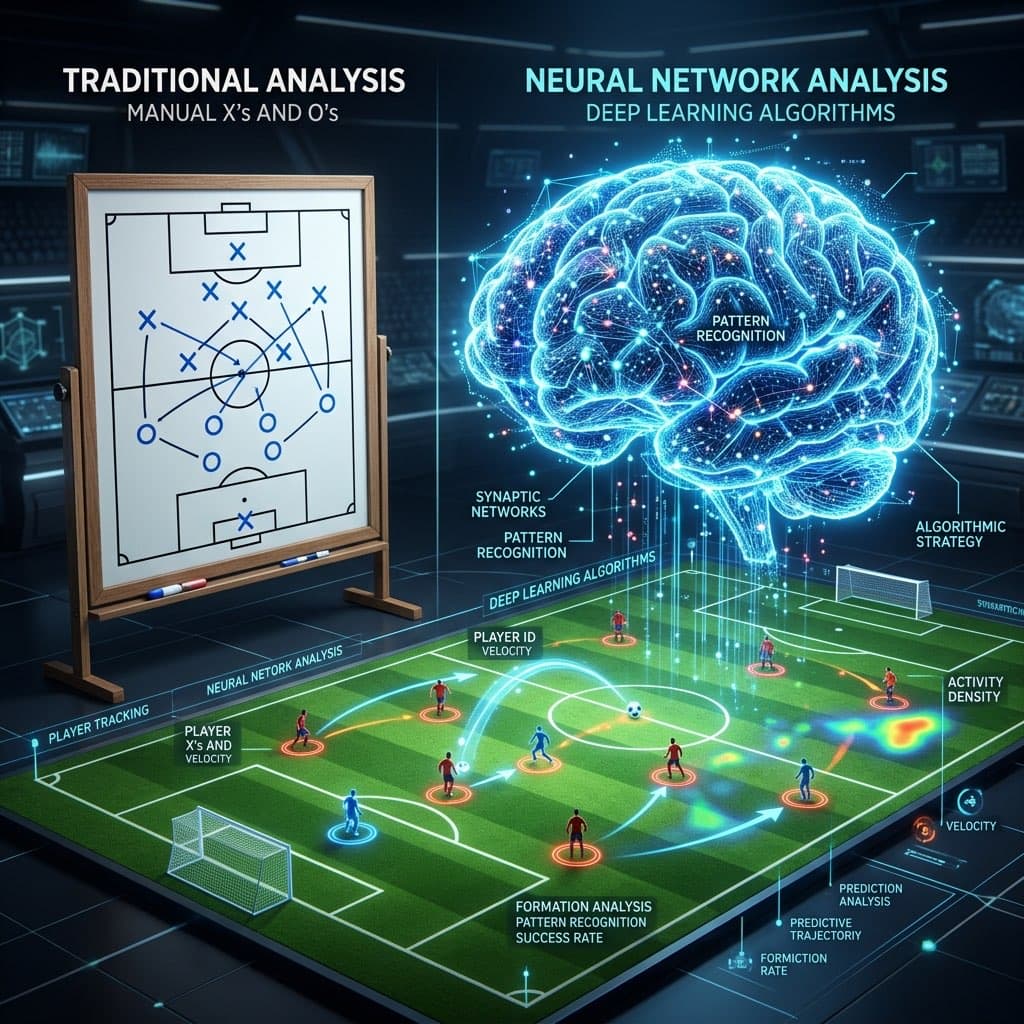
For the past decade, Expected Goals (xG) has been the gold standard for measuring a team's underlying performance. It democratized football analytics, bringing statistical rigor to pub debates and punditry alike.
But as we push deeper into the 2020s, the cracks in the xG model are beginning to show.
The Flaws of Traditional xG
Most public xG models are surprisingly simplistic. They calculate the probability of a shot resulting in a goal based on historical averages of similar shots. The variables typically include:
- Distance from goal
- Angle to the goal
- Body part used (header vs foot)
- Type of pass (cross, through ball)
However, football is a complex, continuous fluid dynamic system. Traditional xG models often fail to account for:
- Defensive Pressure: The exact positioning, velocity, and orientation of defenders around the shooter.
- Goalkeeper Kinematics: Is the goalkeeper off-balance? Are their feet planted?
- Pre-Shot Phase: The sequence of events leading up to the shot, which dictates the momentum of the attacking team.
Two shots from the exact same coordinate on the pitch can have wildly different true probabilities of scoring, yet a traditional model might assign them both an xG of 0.15.
Enter Deep Learning

This is where Neural Networks are changing the game. Instead of relying on a handful of discrete variables, deep learning models ingest raw, continuous tracking data at 25 frames per second.
By analyzing the coordinate positions of all 22 players and the ball simultaneously, Neural Networks can map the spatial geometry of the pitch at the exact moment of the shot. They don't just ask "Where is the ball?"; they ask "What is the structural integrity of the defensive block?"
The FootINet Approach
At FootINet, our proprietary models bypass traditional xG entirely. We use temporal convolutional networks (TCNs) to analyze not just the snapshot of the shot, but the entire preceding possession.
This allows us to generate a new metric: True Goal Probability (TGP). TGP accounts for the velocity of the attacking players, the cognitive load on the defenders, and the precise biomechanical positioning of the goalkeeper.
The Bottom Line
xG was a vital stepping stone in the evolution of football analytics. But in an era where data fidelity is higher than ever, settling for simplistic historical averages is no longer enough. The clubs and analysts who adapt to deep learning will secure the competitive edge, while those clinging to basic xG will be left behind.